
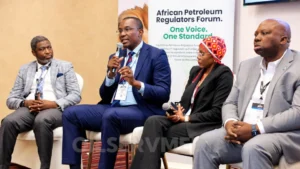
The just-concluded Africa Oil Week (AOW) 2026 in Accra, Ghana, provided a significant platform for African governments, regulators, investors, operators and industry leaders to confront one of the continent’s most persistent energy paradoxes: how to translate abundant natural resources into reliable energy, industrial growth and broad-based economic prosperity.
Among the voices contributing to this critical conversation was Engr. Chuka Eze, FNATE, M.CIoD, who represented Oilserv at a high-level plenary session on “Midstream Development: Monetizing the Molecule, Developing Infrastructure and Getting Product to Market – From Discovery to Market: Building the Midstream Infrastructure Needed to Unlock Value.” His intervention shifted the conversation from policy aspirations to practical infrastructure delivery, drawing on Oilserv’s more than 3 decades of experience developing critical gas infrastructure in Nigeria.
The significance of the engagement lies in the nature of the challenge confronting Africa. While the continent possesses substantial oil and gas resources, the ability to transform those resources into economic value remains constrained by infrastructure deficits, financing challenges, regulatory uncertainty, inadequate technical capacity and fragmented markets. AOW 2026 therefore presented more than another industry gathering; it created an opportunity for governments, regulators and private-sector stakeholders to sit together and examine practical solutions to the structural challenges affecting the energy industry.
For Oilserv, participation in that conversation provided an opportunity to demonstrate that the bridge between the upstream resource and the end user is not theoretical, it is built through engineering expertise, infrastructure, technology, project execution and indigenous capacity.
At the heart of Engr. Chuka’s intervention was a deceptively simple question: Why should Africa continue to flare gas when there is such a pressing need to utilize it domestically? His response identified three broad dimensions of the challenge: commercial considerations, infrastructure deficits and operational realities. From the commercial perspective, operators naturally seek to maximize returns on investments already committed to upstream activities, and export markets can sometimes offer stronger financial incentives than domestic markets. However, policy mechanisms such as Nigeria’s Domestic Gas Delivery Obligation under the Petroleum Industry Act demonstrate how governments can create frameworks that ensure a proportion of available gas is directed towards domestic needs, including power generation, industrialization and gas-based industries.
The second challenge, according to Engr. Chuka, is infrastructure. Gas resources are often distributed across fields and locations, and individual volumes of associated or flare gas may be too small to justify stand-alone investments for monetization. This creates an opportunity for collaboration among operators to aggregate volumes, process them and convert them into commercially useful products such as LPG, etc. He referenced Nigeria’s Gas Flare Commercialization Programme as an example of an initiative designed to address the challenge. However, he stressed that the success of such programmes ultimately depends on implementation capacity, underscoring the importance of ensuring that projects are entrusted to contractors and vendors with the requisite technical competence, capacity and track record to deliver.
The third dimension is operational. In certain circumstances, operators may reinject gas into reservoirs, but where volumes are insufficient for reinjection or other available utilization options, flaring can become the remaining operational alternative. Yet, from both an economic-development and environmental perspective, continuing to flare a resource that could be converted into usable energy represents a significant lost opportunity. Africa’s challenge, therefore, is not simply to produce more hydrocarbons but to develop the infrastructure and commercial models required to capture, process, transport and utilize them effectively. For Oilserv, this is precisely where engineering and infrastructure capability becomes critical: resources beneath the ground only become economically meaningful when they are connected to markets above the ground.
Engr. Chuka also emphasized the importance of gas-to-power within Africa’s energy-development strategy, while cautioning against a one-size-fits-all approach to the energy mix. Countries must consider the resources available to them and develop energy systems that reflect their specific circumstances. Where solar, wind or hydro resources are more abundant, those resources should be developed aggressively; where natural gas is abundant and infrastructure exists to support its utilization, gas can provide a critical foundation for reliable power and industrial development. Nigeria, with its substantial gas reserves and gas-dependent power generation system, presents a compelling case for continued investment in gas-to-power infrastructure while simultaneously expanding renewable-energy capacity.
It is in this context that Oilserv’s track record becomes particularly relevant to the broader AOW conversation. Over more than 3 decades, the company has evolved from its early beginnings into an indigenous EPCIC and infrastructure company executing major national and continental energy projects. Its experience demonstrates the role that capable African engineering companies can play in converting energy resources into tangible infrastructure and economic opportunities. Oilserv’s participation at AOW 2026 therefore reinforced a central message: Africa does not have to wait for external capacity to build the infrastructure required for its energy future. Indigenous companies with the requisite technology, human capital, experience and execution capability already exist and can serve as critical partners in the continent’s energy transformation.
Among the projects highlighted was the Ajaokuta-Kaduna-Kano (AKK) Gas Pipeline, a major gas infrastructure development designed to strengthen the movement of natural gas across the northern corridors of Nigeria. Oilserv’s involvement in the project, including the construction of Lot A across diverse and challenging terrain, demonstrates the scale and complexity of infrastructure that indigenous EPCIC companies can execute. The project also illustrates the wider developmental significance of gas infrastructure: pipelines are not merely conduits for molecules; they create the physical connectivity required to move energy to power plants, industries, commercial centers and communities where it can generate economic activity.
Oilserv’s experience on the Obiafu-Obrikom-Oben (OB3) Gas Pipeline similarly demonstrates the strategic importance of midstream infrastructure in unlocking upstream resources and supporting downstream utilization. The project, which includes a Gas Treatment Plant, reflects the integrated infrastructure approach required to move beyond extraction towards processing and utilization. This is particularly important for Africa, where the absence of adequate midstream infrastructure has historically constrained the ability to monetize gas resources effectively. “Building the infrastructure that connects production to processing and ultimately to the market is therefore central to transforming gas from an underground resource into an engine of industrialization.”
The company’s contribution to gas infrastructure supporting power generation further demonstrates the relationship between energy infrastructure and economic development. Oilserv has provided gas pipeline infrastructure serving power plants, reinforcing the principle that gas development should ultimately be connected to productive economic activity. The example of Geometric Power illustrates the potential impact of reliable electricity on regional industrialization, investment and manufacturing. “When gas infrastructure enables power generation, and reliable power in turn attracts manufacturers and investors, the economic multiplier extends far beyond the original pipeline project. It creates an ecosystem of businesses, employment, investment and productivity,” Chuka said.
The same principle applies to the company’s involvement in gas infrastructure across Lagos. Oilserv’s extensive contribution to the gas distribution network in the state illustrates how energy infrastructure can underpin broader economic transformation. Lagos did not become Nigeria’s commercial hub solely because of its population or geography; its economic strength has also been reinforced by infrastructure that enables businesses and industries to operate. Gas distribution networks, in that sense, are not simply energy assets, they are part of the underlying architecture of modern economies. The lesson for Africa is clear: infrastructure investment must be viewed as a catalyst for economic activity rather than simply as a cost associated with energy production.
The AKK project also demonstrates how strategic gas infrastructure can support the development of major economic centers. With provision for spur lines to supply gas to power-generation facilities serving Abuja, the infrastructure has the potential to support electricity supply, industrial activity, employment and broader economic growth. This illustrates the fundamental proposition advanced by Oilserv at AOW 2026: “the real value of gas is not realized when it is discovered; it is realised when infrastructure connects it to a customer who can convert that energy into productive value.“ From the upstream producer to the power plant, industrial facility or household, every link in that chain is essential.
Engr. Chuka argued that this philosophy reflects a broader shift that Africa must make in its energy conversation, from discussing resources in isolation to discussing the infrastructure systems required to monetize them. Africa has the resources and the markets, but the continent must build the pipelines, processing facilities, power infrastructure, storage systems, transportation networks and industrial platforms capable of connecting the two. This requires investment, but it also requires competent project developers, engineers, contractors, regulators and indigenous businesses capable of translating investment into completed infrastructure. The challenge is therefore not simply attracting capital; it is ensuring that capital is deployed through credible projects and capable institutions to produce infrastructure that works.
Engr.Chuka’s closing message at the conference was consequently one of action. Africa has spent considerable time discussing its resources, policies and development challenges. The continent now needs to move decisively from conversation to implementation mode. Natural resources that remain underground have potential, but potential alone does not constitute economic value. A resource becomes an asset when it is responsibly extracted, processed, transported through appropriate infrastructure and delivered to a market where it can generate economic activity. Africa already has significant demand for energy; what is required is the infrastructure, investment and execution capacity to connect that demand to available resources.
According to him, this is where the role of companies such as Oilserv Limited and Frazimex Engineering Limited becomes strategically important. Indigenous engineering and construction companies can serve as the bridge between upstream resource development and the end user, translating capital investment into physical infrastructure that enables energy to reach the end user. Their role is particularly significant at a time when African countries are seeking to deepen local content, strengthen indigenous capacity and retain more economic value within the continent. Local participation should therefore evolve beyond contract allocation towards building companies capable of executing complex projects safely, efficiently, competitively and to international standards.
The conversation at AOW 2026 also reinforced the importance of partnerships. No single government, operator, investor or engineering company can independently resolve Africa’s energy infrastructure deficit. Governments must establish credible and predictable policy frameworks; regulators must provide clarity and stability; investors must deploy patient capital; operators must develop resources responsibly; and indigenous companies must continue building technical and managerial capabilities. When these elements work together, the continent can create an energy ecosystem in which international investment and African capability reinforce rather than displace one another.
Ultimately, the question facing Africa is not whether it possesses enough resources to transform its economy. It is whether it will build the systems necessary to convert those resources into prosperity. The discussions at AOW 2026 made clear that Africa’s energy future will require a balanced approach in which natural gas and other hydrocarbons continue to support immediate industrial and energy needs while renewable energy expands as part of a progressively diversified energy mix. The objective should be neither to abandon Africa’s hydrocarbons prematurely nor to ignore the need for a sustainable energy future, but to use every viable resource intelligently to expand energy access, strengthen industrial capacity and improve living standards.
For Oilserv, participation at Africa Oil Week 2026 was therefore more than a representation at an international industry conference. It was an opportunity to contribute an indigenous African perspective grounded in decades of practical project execution and infrastructure development. From the challenge of gas flaring to gas-to-power, from midstream infrastructure to regional connectivity, the company’s contribution reinforced a fundamental truth: “Africa’s energy transformation will not be achieved by resources alone. It will be achieved by the people, companies, institutions, technologies and infrastructure capable of turning those resources into productive economic value,” Chuka Eze.