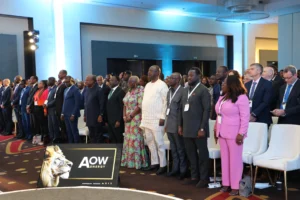
At the Local Content Plenary Session co-hosted by the Nigerian Content Development and Monitoring Board (NCDMB) and the Ghana Petroleum Commission, industry leaders came together to tackle an urgent question: how can Africa move from conversation to implementation on cross-border Oil and Gas projects?
-Emeka-Okwuosa,-FNSE,-FIoD,-CON,-GCEO-Oilserv-Group-At-AOW-Energy-Week,-Accra,-Ghana/2114059059-0H9A6318.JPG)
Moderated by Paul Morton (Herbert Smith Freehills Kramer), the panel brought together technical, policy and commercial perspectives, including the Chairman and Group CEO of Oilserv Group, Engr. (Dr.) Emeka Okwuosa CON, alongside representatives from Chemslov Ghana and AFREC Senegal.
This comprehensive account expands the session’s key insights and translates them into a practical roadmap, emphasizing Oilserv’s Pan-African footprint, Frazimex’s engineering leadership, and the NCDMB’s catalytic role in creating opportunities and building trust.
-Emeka-Okwuosa,-FNSE,-FIoD,-CON,-GCEO-Oilserv-Group-At-AOW-Energy-Week,-Accra,-Ghana/109941714-0H9A6233.JPG)
During a high-energy panel session themed “Cross-border Projects and Knowledge Exchange,” the room buzzed with anticipation as Engr. Chuka Eze, Managing Director of Frazimex Engineering Limited speaking on behalf of Engr. (Dr.) Emeka Okwuosa CON, took the stage, his words painting a vivid picture of Africa’s boundless energy potential.
With warmth, conviction, and visionary tone, Engr. Chuka captured the audience’s attention as he addressed the topic of the plenary session, weaving his insights into a compelling roadmap for Africa’s energy future. He outlined three strategic pathways he believes are essential for the continent to scale up its upstream capacity and fully unlock its natural resource potential.
-Emeka-Okwuosa,-FNSE,-FIoD,-CON,-GCEO-Oilserv-Group-At-AOW-Energy-Week,-Accra,-Ghana/3895839162-vlcsnap-2025-09-21-10h39m57s134.png)
First, he championed the power of continental synergy, reminding everyone that Africa’s true prosperity lies in its ability to work as one, sharing expertise, infrastructure, and ambition to drive collective growth. He stressed that continental synergy is not just important but indispensable, allowing nations to tap into existing expertise and proven technical capabilities rather than “reinvent the wheel.” Given the operational complexities of the upstream sector, he urged African countries to learn from those who have already mastered the process, leveraging their knowledge to extract resources efficiently and sustainably.
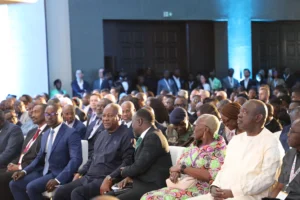
For Engr. Emeka Okwuosa, cooperation across the entire Oil and Gas value chain, beginning with upstream development is the key to unlocking shared prosperity and solving Africa’s challenges the African way. His passionate call for unity and innovation left the audience inspired, envisioning an Africa that harnesses its own resources, expertise, and partnerships to power a brighter, self-defined energy future.
-Emeka-Okwuosa,-FNSE,-FIoD,-CON,-GCEO-Oilserv-Group-At-AOW-Energy-Week,-Accra,-Ghana/2047070730-0H9A6294.JPG)
Next, he highlighted the critical need for accurate and accessible data, noting that sound decisions and smart investments depend on reliable information that gives investors and policymakers the confidence to act boldly. Engr. Chuka repeated emphasized the NCDMB’s role, highlighting it as a game-changer. Through initiatives such as the Nigerian Oil and Gas Opportunity Fair (NOGOF) and the Service Providers Qualification System, the Board has helped create transparent pathways for local firms to identify upcoming projects, understand procurement timelines and position themselves to bid or partner.
-Emeka-Okwuosa,-FNSE,-FIoD,-CON,-GCEO-Oilserv-Group-At-AOW-Energy-Week,-Accra,-Ghana/1588207096-0H9A6300.JPG)
That qualification database; a curated, competency-based registry, gives operators confidence that they can source fit-for-purpose indigenous contractors, and it reduces information asymmetries that often block local participation. He added that private and quasi-industry bodies such as PETAN (Petroleum Technology Association of Nigeria) and the emerging African Partner Pool (championed by Ibrahima Talla) build on that foundation by creating sectoral seals of quality and continent-wide opportunity listings. Taken together, these platforms are the infrastructure of trust: searchable records, periodic assessments, and a visible pipeline of work.
-Emeka-Okwuosa,-FNSE,-FIoD,-CON,-GCEO-Oilserv-Group-At-AOW-Energy-Week,-Accra,-Ghana/4132227902-0H9A6286.JPG)
Oilserv’s success story, as described by Engr. Chuka, is emblematic of how deliberate capacity development and persistence can yield continental impact. What began with modest local contracts; “refurbishing of swimming pool,” has matured into a three-decade journey that positions Oilserv as a trusted Engineering, Procurement and Construction (EPC) contractor across multiple African markets. Today Oilserv operates across Nigeria, Benin, Ghana, Togo and Uganda, providing a model for how indigenous firms can scale technically and geographically.
The significance of Oilserv’s footprint goes beyond company growth. Each project delivers direct economic value, infrastructure that raises domestic energy security, while generating secondary impacts: local jobs, skills transfer, supply-chain development and structured graduate training that links young engineers to large, complex projects. As Engr. Chuka emphasized, these outcomes embody the NCDMB’s mandate: transform local content into real competence and commercial opportunity.
-Emeka-Okwuosa,-FNSE,-FIoD,-CON,-GCEO-Oilserv-Group-At-AOW-Energy-Week,-Accra,-Ghana/2913010879-0H9A5994.JPG)
He continued that Frazimex plays the complementary technical role: engineering design and project definition that make large projects buildable and bankable. Two flagship projects discussed at the plenary illustrate the point:
The Obiafu–Obrikom–Oben (OB3) Gas Infrastructure, Frazimex executed the engineering design for a pipeline and gas treatment complex that includes a 48-inch X 128km pipeline and a 2bscf/day treatment plant configured in four trains (each rated 500mscf). Oilserv executed procurement and construction; the system is now delivering substantive volumes of gas (above 300mscf at the time of reporting). That coupling, rigorous front-end engineering followed by disciplined construction execution, demonstrates a proven African delivery chain for large gas assets.
The Ajaokuta–Kaduna–Kano (AKK) Pipeline (Segment 1), a 40-inch X 614km pipeline designed to route gas from Nigeria’s middle belt to the north, AKK demonstrates Oilserv’s capacity to execute across “unimaginable terrains,” applying engineering solutions at scale.
These projects show two critical things: first, Africa has the technical know-how to design and deliver world-scale energy infrastructure; second, a close collaboration between engineering houses and EPC contractors creates a replicable template for cross-border projects.
-Emeka-Okwuosa,-FNSE,-FIoD,-CON,-GCEO-Oilserv-Group-At-AOW-Energy-Week,-Accra,-Ghana/2874429301-0H9A6197.JPG)
Finally, Engr. Chuka called for the relaxation of visa restrictions across African borders which impede personnel exchange, skills transfer, and rapid project mobilization. He therefore called for “mobility frameworks, a simple yet transformative step to ease movement across borders, foster collaboration, and accelerate the exchange of skills and technology. He called on governments across the continent to put in place business-friendly policies, stressing that clients and customers are doing their best to bring projects to live, but the right policies must be available that can help solve continental problems.”
-Emeka-Okwuosa,-FNSE,-FIoD,-CON,-GCEO-Oilserv-Group-At-AOW-Energy-Week,-Accra,-Ghana/4234442777-0H9A6230.JPG)
“We do have problems that we need to solve, we do have the natural resources in abundant, we do have the skill and although there’s room for improvements to solve these problems; we just need to move into implementation mode so that by the time we come back here or any other forum next time, we will be looking at the outcomes of the various conversations we have made so far. Most importantly, the continental synergy, we can’t just walk alone, there are some synergies we can leverage on. Take what has worked best in one country and leverage it in another country in other to optimize the resources and get a better desired output.”
-Emeka-Okwuosa,-FNSE,-FIoD,-CON,-GCEO-Oilserv-Group-At-AOW-Energy-Week,-Accra,-Ghana/888294979-0H9A6237.JPG)
Through these three pathways, Engr. Chuka painted an inspiring picture of an Africa ready to harness its abundant resources, attract investment, and emerge as a true powerhouse in the global energy landscape. He concluded by stating that these pathways are practical and solvable, but only if industry, governments and regulators act in concert;
- Without transparent pipelines of work, cross-border partnerships cannot form. The NCDMB’s fairs and accurate databases are a model for other nations to replicate.
- While expertise exists, scaling it across borders requires deliberate upskilling programs, apprenticeships and joint ventures that embed transfer of know-how into contracts.
-Emeka-Okwuosa,-FNSE,-FIoD,-CON,-GCEO-Oilserv-Group-At-AOW-Energy-Week,-Accra,-Ghana/1751612694-0H9A6082.JPG)
- Successful partnerships depend on predictable standards (trust and shared values) and integrity, not identical corporate cultures. Shared qualification frameworks and periodic joint audits build confidence.
- A central theme was that shared infrastructure and accessible, credible data significantly reduce project costs and speed deployment. Network codes, regional hubs, and common data repositories will enable investors to evaluate project returns more rapidly and allocate capital with greater confidence. Where countries or regional bodies publish project pipelines and standardized technical specifications, suppliers can scale and create cross-border supply chains, lowering unit costs across the board.
-Emeka-Okwuosa,-FNSE,-FIoD,-CON,-GCEO-Oilserv-Group-At-AOW-Energy-Week,-Accra,-Ghana/3417253534-0H9A6086.JPG)
The plenary reinforced a powerful takeaway truth: Africa has the resources, the technical expertise, and the nascent institutional architecture to deliver its own energy future, if leaders convert the momentum of conversation into durable, cross-border action. Oilserv and Frazimex demonstrate the commercial and technical blueprint; the NCDMB demonstrates how a regulator can catalyze capacity. What remains is wider policy alignment, easier mobility, shared data and deliberate skill transfer, and practical steps that can turn continent-wide aspiration into delivered infrastructure, jobs and long-term prosperity.
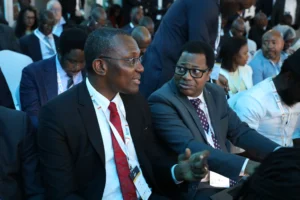 At Oilserv Group, we’re not just building pipelines; we’re connecting nations, unlocking prosperity, and shaping Africa’s energy future.