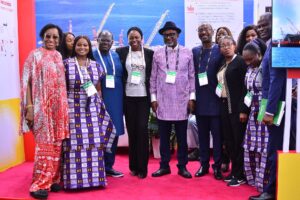
In a year defined by renewed optimism across Nigeria’s energy landscape, the 2025 Practical Nigerian Content (PNC) Forum convened leaders from government, industry, and finance to announce what may be the boldest set of local content interventions since the passage of the NOGICD Act. The Forum, attended by over 725 delegates, 460 exhibitors, and 56 VIP speakers, opened with a surge of strategic declarations aimed at transforming Nigeria’s oil and gas sector into a globally competitive, innovation-driven, and investor-attractive industry.

It was at the heart of Yenagoa, that Engr. Felix Omatsola Ogbe, Executive Secretary of the Nigerian Content Development and Monitoring Board (NCDMB), delivered a keynote address that set a decisive tone for Nigeria’s next phase of energy development. His announcement: a $100 million Equity Investment Scheme designed to catapult high-growth indigenous energy service companies into a new era of industrial capacity and sustainable competitiveness.
In his address, Engr. Ogbe unveiled the Equity Investment Scheme as a new flagship product under the Nigerian Content Intervention Fund (NCI Fund). Developed in partnership with the Bank of Industry (BOI), the fund aims to provide equity and quasi-equity capital bridging a long-standing financing gap that has restricted Nigerian companies from scaling into global-standard energy players.
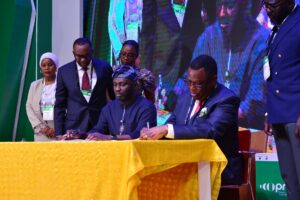
To operationalize this financing pipeline, NCDMB and BOI signed a Memorandum of Understanding (MoU) during the Forum. The partnership introduces an uncommon financing structure in the sector: long-term risk capital that complements debt financing and offers a more flexible runway for indigenous companies to expand, innovate, and compete on a continental stage.
Ogbe further revealed that Nigerian Content levels have reached an impressive 61% as of Q3 2025, a marker of substantial progress in local value retention and indigenous participation.

Building on this momentum, the NCDMB Executive Secretary announced several strategic initiatives:
- Onboarding of a new cohort of Project 100 Companies, following the strong performance of the initial batch launched in 2019.
- Launch of the NCDMB Technology Challenge in early 2026, designed to inspire home-grown innovation and engineering excellence.
- Hosting of a Research and Development Fair in mid-2026 to deepen research commercialization and industry-academia collaboration.
- Comprehensive review of seven existing Board guidelines, ensuring regulatory frameworks remain agile and responsive to evolving industry realities.
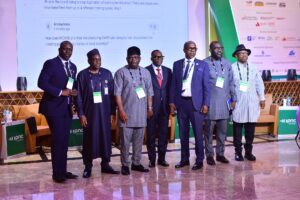
Ogbe also confirmed that beginning 1 January 2026, the Board will introduce the NCDF Compliance Certificate, a mandatory requirement for companies seeking NCDMB permits and approvals, verifying compliance with the statutory 1% remittance obligation.
The Executive Secretary highlighted significant growth in local empowerment structures, including:
- Expansion of the Community Contractors Scheme, with over 94 disbursements in 2025.
- Full operationalization of the Nigerian Content Academy, which has already delivered multiple industry lecture series.
- Rollout of the Oil and Gas Field Readiness Training Programme to prepare Nigerians with the top technical skills required for newly emerging multi-billion-dollar oil and gas projects.
In his goodwill message, Dr. Olasupo Olusi, Managing Director/CEO of the Bank of Industry, hailed the partnership with NCDMB as a major step forward. He reaffirmed BOI’s commitment to deploying equity capital where debt alone cannot unlock potential, describing the fund as a “milestone instrument for de-risking indigenous participation.”
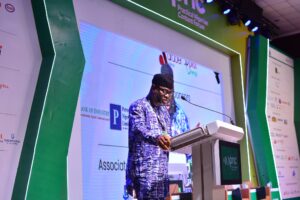
He emphasized the $5 million single obligor limit, designed to catalyze multiple high-impact investments while maintaining strong governance and prudent risk management. BOI, he said, remains committed to financing businesses with the capacity to scale, compete globally, and deliver sustainable value to the Nigerian economy.
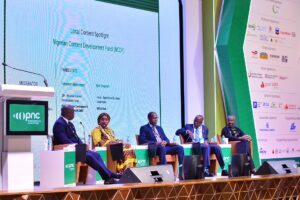
Delivering a hard-hitting goodwill message, Senator Joel Onowakpo Thomas, Chairman of the Senate Committee on Local Content, called for the eradication of “paper compliance.” He insisted that local content must reflect measurable expatriate substitution, real job creation, and genuine skills transfer.
He stressed that Nigeria has moved past symbolic commitments: “Local content is no longer a slogan. It must become a living economic reality.” Senator Thomas also pledged that the Committee will uphold transparency, fairness, and accountability while protecting the interests of both international investors and domestic stakeholders.

In one of the Forum’s most anticipated interventions, Senator Heineken Lokpobiri, Minister of State for Petroleum Resources (Oil), opened his address by underscoring the transformative impact of sustained policy reforms. He reiterated that regulatory clarity, consistency, and transparency have begun to reverse years of stagnation in Nigeria’s oil and gas sector, attracting renewed investor interest and positioning the country favorably in the continental energy landscape. According to industry coverage, Nigeria’s recent success in securing three out of Africa’s four major Final Investment Decisions (FIDs) in 2024 signals growing confidence from global capital.

Central to this narrative is the Petroleum Industry Act (PIA) 2021, which Lokpobiri described as a pivotal turning point that restored predictability to the legal and regulatory environment. He stressed the need for predictable taxation, transparent regulatory processes, and competitive fiscal terms to benchmark Nigeria against established global energy hubs such as Houston, Paris, and London, ensuring the country remains attractive to long-term investors. Recognizing operational challenges, especially in deepwater project execution, Lokpobiri called for the removal of inefficiencies introduced by middlemen and advocated direct engagement with competent local contractors. He also highlighted the importance of enhanced collaboration between the executive and the National Assembly to eradicate regulatory bottlenecks that have historically slowed project delivery. Reaffirming the strategic priority of local content, the Minister warned that misapplication of local content laws could inadvertently increase costs and deter investment, stressing that policy enforcement must be balanced with operational efficiency to encourage sustainable growth.

On the gas side, Rt. Hon. Ekperikpe Ekpo, Minister of State for Petroleum Resources (Gas), reiterated gas as central to Nigeria’s long-term economic and industrial growth. He cited progress under the Decade of Gas Initiative and outlined commitments to upstream incentives, flare-commercialization, and major infrastructure projects such as the AKK, OB3, and Nigeria–Equatorial Guinea pipelines. Ekpo noted that gas-driven industrialization is advancing through investments in fertilizer plants, CNG and LPG expansion, clean cooking solutions, small-scale LNG, methanol, petrochemicals, and emerging gas-based industrial parks. While commending President Bola Ahmed Tinubu’s leadership, he praised the NCDMB under Engr. Felix Omatsola Ogbe for advancing local content through infrastructure, capacity building, and support for indigenous manufacturing. He concluded by reaffirming gas as Nigeria’s strategic bridge fuel and urged sustained collaboration to secure a resilient and prosperous energy future.

In her keynote address at the Practical Nigerian Content (PNC) Forum 2025, Olu A. Verheijen, Special Adviser to the President on Energy, reaffirmed the Federal Government’s commitment to reforms that enhance efficiency, competitiveness, and resilience in Nigeria’s energy sector. She praised the NCDMB for sustaining the PNC Forum as a vital accountability platform and stressed that, in a highly competitive global energy environment, local content must operate as an industrial strategy that delivers value, reduces cost, and ensures large-scale project execution.
Verheijen highlighted Presidential Directives 41 and 42, which were introduced to eliminate contracting inefficiencies, reduce rent-seeking, and shorten project timelines, measures that enabled Nigeria to secure three of Africa’s four major FIDs in 2024. She emphasized that Nigeria’s competitiveness depends on coordinated action among government, regulators, operators, financiers, and host communities, and called for deliberate development of in-country value through skills enhancement, industrial infrastructure, and local enterprise growth.
She celebrated the transfer of onshore assets from IOCs to indigenous operators as proof of Nigeria’s growing domestic capacity, with notable gains in technology adoption, community engagement, and production restoration. Verheijen cited successful local content models, including modular refineries, fabrication yards, NLNG Train 7, and NOGAPS industrial parks, and noted that the NOGICD Act has increased in-country value retention from 5% to 56%, translating into jobs, technology transfer, and expanded industrial capability.

Looking forward, she emphasized Nigeria’s targets of producing three million barrels of oil and 10 bscf/day of gas by 2030, urging regulators to act as enablers and calling for innovative financing and expanded local content funding to unlock key projects. She concluded by encouraging all stakeholders to sustain reform momentum and work collectively to build a resilient, competitive energy economy grounded in local capacity, industrial growth, and shared national prosperity.
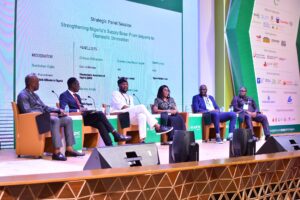
At the second Strategic Panel Session, industry leaders examined how the Nigeria First Policy will transition from a policy aspiration to a measurable national development tool. The Nigerian Content Development and Monitoring Board (NCDMB) reiterated that local content has consistently proven its value, and emphasized the need for deeper alignment between Nigeria’s policy objectives and the provisions of the NOGICD Act to amplify national impact.

Representing the Chairman/GCEO of Oilserv Group, Engr. Dr. Emeka Okwuosa CON, the Group’s General Manager, Commercial and Business Development, Engr. Cheta Okwuosa, offered practical perspectives on what is required to fully actualize the Nigeria First Policy. He highlighted that creating an enabling operating environment, characterized by predictable regulation, transparent implementation processes, and improved access to financing, is critical to accelerating investment and strengthening indigenous participation.
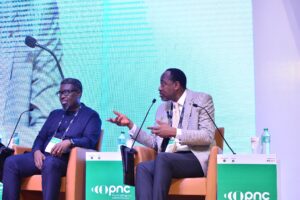
Engr. Cheta further stressed that capacity building, enhanced technical competence, and deliberate knowledge and technology transfer must accompany policy enforcement. According to him, these elements are essential to unlocking large-scale gas infrastructure development, deepening industry competitiveness, and positioning Nigerian companies as credible players within regional and global value chains.

He also underscored the importance of registration on the NOGIC-JQS platform, which remains a gateway for indigenous service providers to access business opportunities. He offered insights into forthcoming training programmes and shared motivational guidance aimed at helping Nigerian companies effectively prepare for upcoming opportunities. Interactive engagements during the session reinforced the NCDMB’s commitment to ensuring that the Nigeria First Policy continues to deliver sustainable and inclusive sectoral growth.

The Forum concluded with a robust Townhall Meeting, where stakeholders engaged directly with NCDMB leadership on policy clarity, compliance expectations, and collaborative pathways for growth. The open dialogue reinforced the Board’s commitment to transparency and partnership.

With 460 exhibitors, 725 delegates, and an impressive lineup of speakers, including leading CEOs, regulators, ministers, and global energy executives, the 2025 PNC Forum stands as one of Nigeria’s most consequential platforms for shaping the future of the energy industry.